
From pilots to pipelines: what H2Uppp says about the real work of building hydrogen markets
From pilots to pipelines: what H2Uppp says about the real work of building hydrogen markets
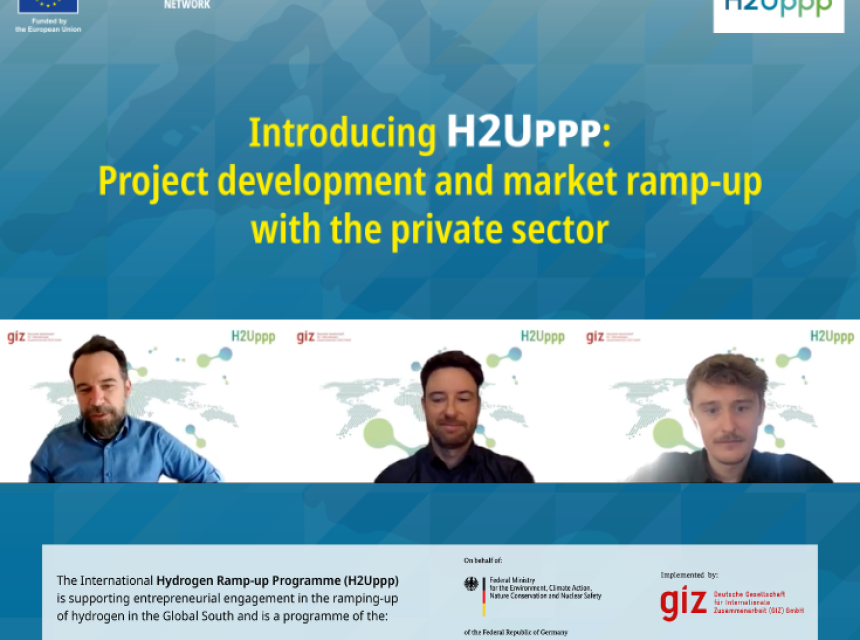
At a MED-GEM Network webinar, GIZ’s H2Uppp team offered a useful reality check on the green hydrogen market. The sector is moving, but it remains early-stage, fragmented and heavily dependent on project preparation, risk reduction and public-private cooperation. The core message was straightforward: hydrogen markets will not scale through ambition alone, but through bankable projects, practical tools and better coordination.
Presented by Claudio Cinquemani, Philip Miltrup and Veit Raisch, H2Uppp was framed as a hands-on programme focused on the most fragile part of the value chain: the stage before major investment, when projects still need to prove their technical, economic and institutional viability. Its approach combines project identification, project development and support to implementation and trade, with the aim of turning early ideas into more credible pipelines.
The examples discussed during the session showed what that means in practice. In Chile, a PPP with K-UTEC explored how reject brine from desalination could become a value stream rather than pure waste. In Brazil, a project on green methanol from biogas and green hydrogen highlighted both the promise of integrated low-carbon pathways and the complexity of certification and emissions accounting. Another PPP focused on developing a carbon market methodology for fertilisers produced with green ammonia, raising important questions around carbon revenues, exportability and double counting.
Other cases widened the lens. A green ammonia industrial park in Chile illustrated the value of shared infrastructure, coordinated port planning and early public-sector involvement. A still ongoing study in Morocco and Egypt is examining the potential of LOHC-based hydrogen transport, with a focus on infrastructure and regulation. Meanwhile, projects in India and elsewhere showed that market ramp-up also depends on less visible but equally important building blocks: trading platforms, modular industrial applications, training systems and practical market organisation.
If one conclusion stood out, it was this: green hydrogen markets will be built through ecosystems, not isolated assets. Throughout the discussion, participants came back to the same concerns: infrastructure, local acceptance, policy clarity, certification, carbon accounting and replicability. The interest was clearly not in generic narratives, but in concrete pathways that can be adapted to regional realities, including in the Southern Mediterranean.
For MED-GEM, the webinar confirmed that the community is ready for more practical, region-specific engagement. H2Uppp’s experience offers more than examples. It offers a working method for addressing the missing middle between strategy and investment. If the region wants hydrogen projects that are not only announced but prepared, financed and implemented, it will need more of this type of exchange: technical, grounded and honest about the real constraints.
Key takeaways
- Early-stage project development remains the main bottleneck.
Prefeasibility work, partner matching and regulatory clarity are still decisive. - PPPs can reduce risk and unlock private capital.
Limited public support can help move projects closer to investment readiness. - Shared infrastructure matters.
Ports, storage, desalination, land access and industrial clustering are part of project viability. - Certification and carbon accounting are now central.
Questions around RFNBOs, carbon markets and double counting directly affect bankability. - The region wants practical cooperation.
The strongest interest came from participants looking for applicable models, not abstract vision. - MED-GEM can build on this.
The session opened the door to more targeted cooperation, follow-up exchanges and region-specific learning.