
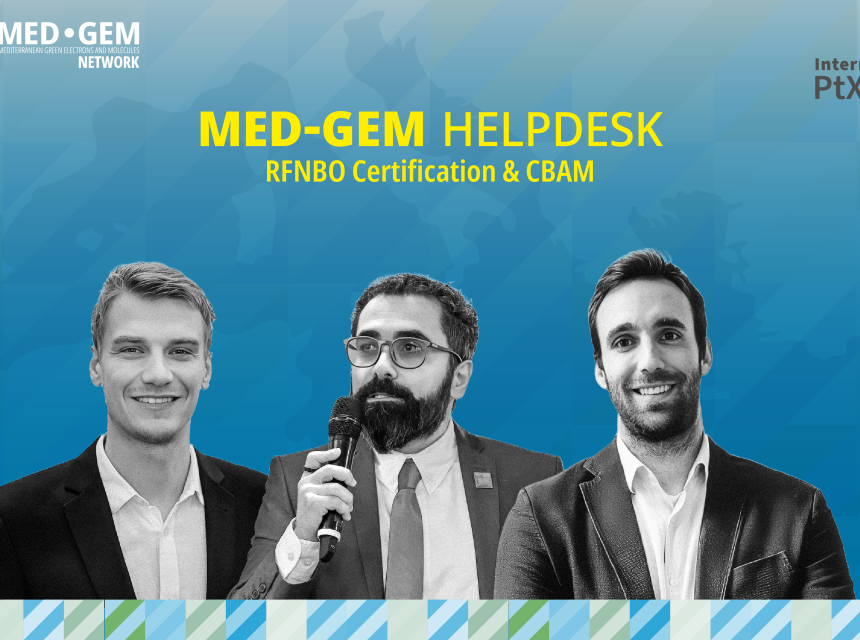
RFNBO Certification and CBAM: Lessons from the MED-GEM Helpdesk
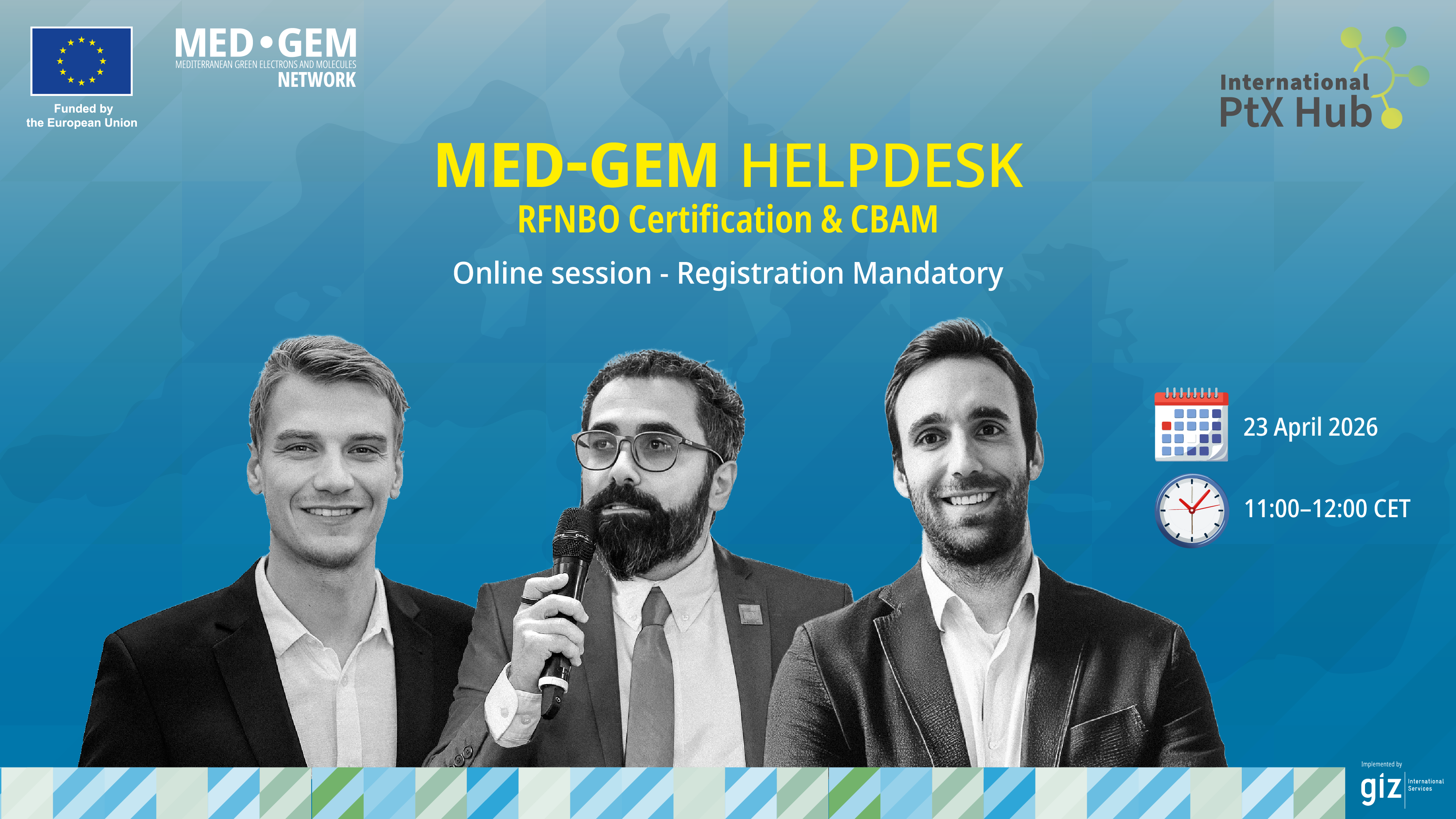
MED-GEM Helpdesk Session | Advancing clarity on RFNBO certification and CBAM
On 23 April 2026, the MED-GEM Network hosted a new Helpdesk info session bringing together technical experts, policymakers and stakeholders from across partner countries to address one of the most pressing challenges in the hydrogen transition: navigating the complexity of EU certification and regulatory frameworks.
The session focused on two critical pillars shaping access to the European market: RFNBO certification and the role of Guarantees of Origin (GoOs) in the context of CBAM. It aimed to strengthen understanding, reduce uncertainty and support partner countries in building the necessary readiness to engage in emerging hydrogen value chains.
Opening the session, MED-GEM Technical Manager Toufic Rizkallah highlighted the importance of aligning technical understanding with evolving EU regulatory requirements, particularly as partner countries position themselves to benefit from first-mover advantages in renewable hydrogen exports.
From theory to practice: lessons from the RFNBO Certification Compendium
Jan-Hendrik Scheyl presented key insights from the RFNBO Certification Compendium, a comprehensive body of work based on workshops and case studies conducted across multiple non-EU countries.
The findings clearly show that certification remains one of the main sources of uncertainty for project developers. While the EU framework builds on well-established principles from biofuels, its application to hydrogen and Power-to-X projects introduces new layers of complexity, particularly in areas such as electricity sourcing, compliance processes and institutional readiness.
A key message emerging from the session is that certification challenges are not project-specific, but systemic. Similar questions arise across regions, confirming the need for shared tools and platforms such as the MED-GEM Helpdesk to support collective learning and risk reduction.
The Compendium also highlighted recurring technical questions raised by developers, including the treatment of electricity sourcing strategies, CO₂ inputs, emission allocation across co-products, and the distinction between certification and proof-of-sustainability mechanisms.
Guarantees of Origin and CBAM: clarifying a widespread misconception
The second part of the session, led by Antonio Fernandez Rodriguez, addressed one of the most frequently asked questions received by the Helpdesk: can Guarantees of Origin be used for RFNBO certification or CBAM compliance?
The answer is clear: no.
While GoOs play an important role in renewable electricity markets, they are designed as a disclosure tool, not as a compliance instrument. RFNBO certification relies on a mass-balance system ensuring traceability across the value chain, while CBAM focuses on the carbon content of products through verified emission factors.
This distinction is essential. As highlighted during the session, different regulatory frameworks pursue similar climate objectives but operate through fundamentally different logics and proof systems. Misinterpreting these roles can lead to compliance risks and project delays.
At the same time, the discussion opened an important forward-looking perspective: while GoOs cannot be used directly for compliance, the data they generate could potentially support certification processes in the future, provided further alignment between systems is explored.
Bridging gaps in a rapidly evolving regulatory landscape
Beyond technical clarifications, the session underscored a broader reality: the regulatory environment for hydrogen is evolving rapidly, and not all aspects are fully stabilised.
Participants raised concrete, operational questions reflecting real project challenges, from emission factor calculations to verification requirements and the interaction between different compliance systems.
This confirms the critical role of the MED-GEM Helpdesk as a practical interface between policy frameworks and project implementation, enabling stakeholders to move from theoretical understanding to actionable insights.
The strong engagement during the Q&A session also highlighted growing demand for deeper, more operational exchanges, reinforcing the need to scale up such formats.
Key Takeaways
- Certification remains a major bottleneck
RFNBO certification is still perceived as complex, with significant knowledge gaps among project developers and institutions. - Regulatory frameworks follow different logics
RFNBO certification and CBAM pursue similar climate goals but rely on distinct compliance mechanisms that should not be conflated. - Guarantees of Origin are not compliance tools
GoOs cannot be used as proof for RFNBO certification or CBAM reporting, despite widespread assumptions. - Data and institutional readiness are critical
Reliable emission factors, regulatory clarity and coordination with certification schemes are essential to enable compliance. - Common challenges across regions
Issues faced by developers are highly consistent across countries, confirming the need for shared tools and regional dialogue. - Helpdesk as a key enabler
The MED-GEM Helpdesk plays a central role in reducing uncertainty, supporting decision-making and accelerating project readiness.
What’s next
Building on this session, MED-GEM will continue its Helpdesk series with upcoming discussions focusing on CBAM verification and the role of accredited verifiers, further supporting stakeholders in navigating compliance requirements.
Stakeholders are encouraged to continue engaging with the Helpdesk and consult the evolving FAQ database for practical, up-to-date guidance.