
From Molecules to Data: Why the Future of Green Hydrogen is Also Digital
From Molecules to Data: Why the Future of Green Hydrogen is Also Digital
The global race for green hydrogen is accelerating across the Mediterranean. From North Africa to the Middle East, countries are investing in renewable energy, industrial capacity and export potential to position themselves as key partners in the emerging hydrogen economy. But behind the headlines on electrolyser capacity and export corridors, a quieter transformation is taking place. Hydrogen is not only reshaping energy systems. It is also transforming the way these systems operate.
A new generation of hydrogen systems
Traditionally, hydrogen facilities have been understood as heavy industrial infrastructure. Today, this perception is rapidly evolving.
The next generation of hydrogen plants is increasingly defined by digitalisation.
Sensors continuously monitor performance.
Data streams enable real-time decision-making.
Predictive analytics anticipate maintenance needs.
Artificial intelligence supports optimisation and efficiency.
In this new paradigm, hydrogen facilities are no longer only physical assets. They are becoming complex, data-driven systems.
A critical challenge: the workforce transition
Across MED-GEM partner countries, this shift is creating a new and urgent challenge.
The hydrogen workforce of tomorrow will require more than energy expertise.
Operators, technicians and engineers will increasingly need to navigate digital environments, manage data and interact with advanced control systems. This includes:
- SCADA and digital control systems
- Predictive maintenance and monitoring tools
- Digital asset management platforms
- AI-supported operational systems
- Cybersecurity protocols
Without these competencies, the deployment of hydrogen projects risks facing a new bottleneck: the lack of digitally skilled professionals.
Bridging the gap between energy and digital skills
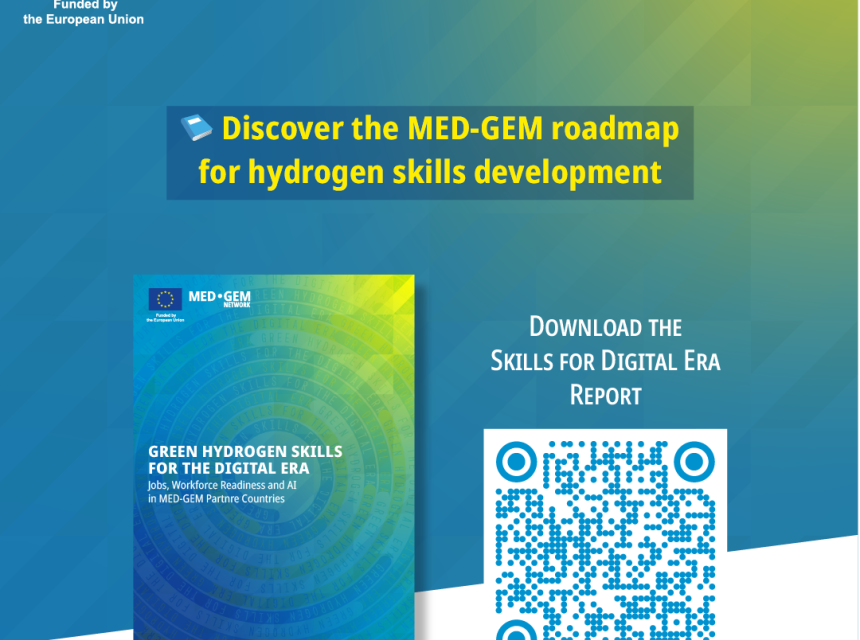
This is precisely the focus of the latest report developed under the EU-funded MED-GEM Network.
The report explores the intersection between green hydrogen, workforce development and digital transformation across the Southern Mediterranean. It highlights how the energy transition is also becoming a transformation of jobs, skills and training systems.
Key insights include:
- The growing demand for hybrid profiles combining engineering and digital skills
- The need to adapt education and vocational training systems to emerging industry requirements
- The importance of early anticipation, as skills development takes time while hydrogen markets are rapidly evolving
- The opportunity to leverage existing capabilities in digital, industrial and energy sectors
A roadmap for action
Beyond analysis, the report proposes a forward-looking roadmap to support partner countries in preparing their workforce for this transition.
It calls for stronger collaboration between industry, academia and policymakers, and for the integration of digital competencies into hydrogen-related training pathways from an early stage.
By doing so, countries can not only avoid future skills shortages, but also strengthen their competitiveness in the global clean energy market.
A transition that is technological, digital and human
The hydrogen transition is often framed in terms of infrastructure, investment and technology.
Yet its success will ultimately depend on people.
Ensuring that the workforce is equipped with the right skills, including digital capabilities, is essential to move from ambition to implementation.
Because the future of hydrogen is not only about molecules.
It is also about data, systems, and the people who make them work.
Discover & Download the full report