Why the next battle for green shipping won't be won on the molecule
Why the next battle for green shipping won't be won on the molecule
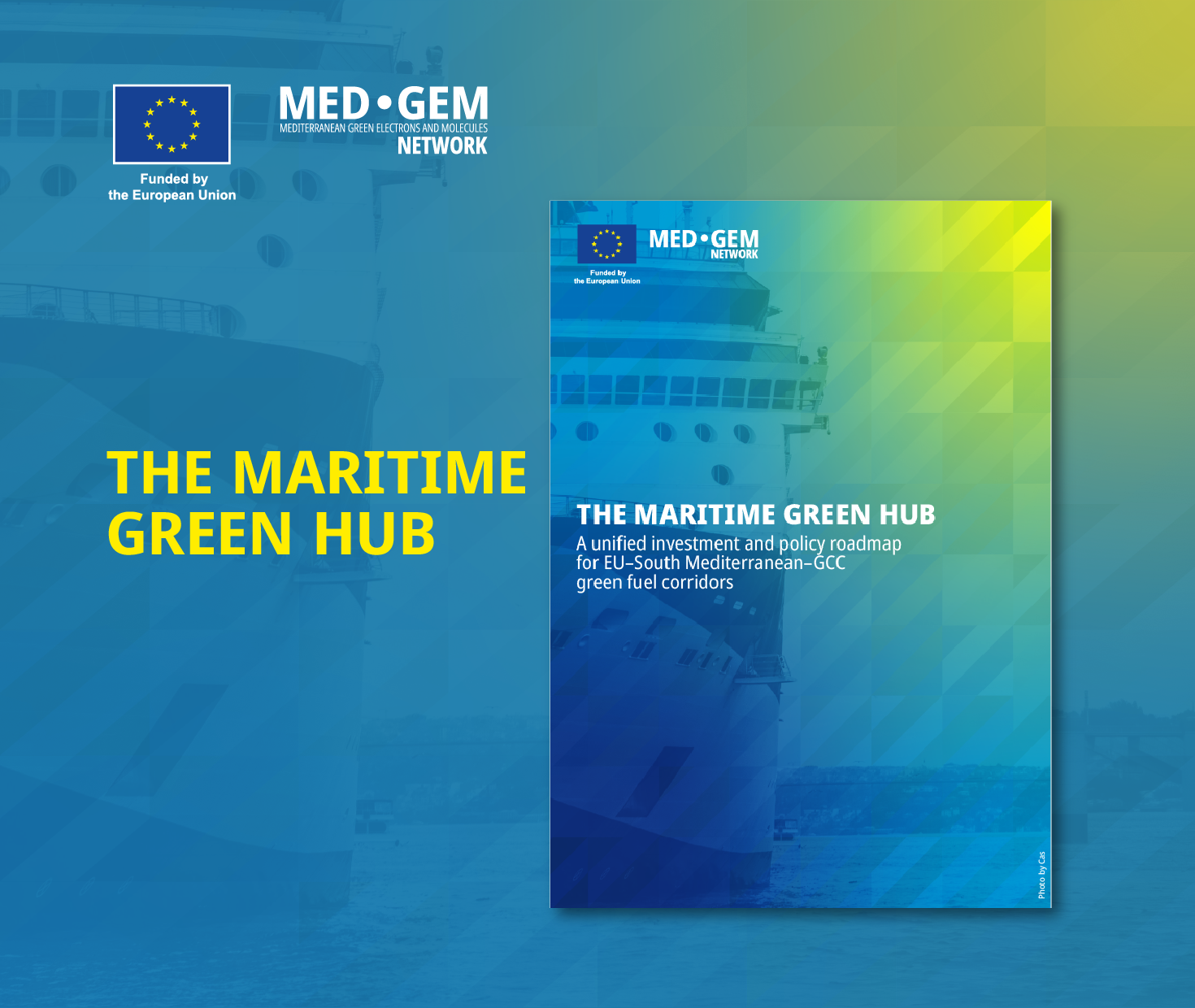
An editorial introduction to The Maritime Green Hub, the new MED-GEM Network report
The countdown has already started
In November 2026, the International Maritime Organization is expected to formally adopt its Net-Zero Framework. By January 2029, every ship calling at a European port will have to prove that its onboard energy is low-carbon: or pay for it. FuelEU Maritime has already turned that future into a present-tense obligation for shipowners, ports and fuel suppliers.
And yet, behind the regulatory mechanics, one strategic question remains strangely under-discussed: where, exactly, will compliant fuels be produced, converted, certified, bunkered and financed at the scale Europe is about to require?
This is the question The Maritime Green Hub, the new MED-GEM Network report authored by Dr. Mustapha Taoumi, sets out to answer.
A thesis that reframes the debate
The central argument of the report is deliberately sharp:
- The premium will not sit in the molecule: it will sit in the corridor.
That single line reframes a decade of conversation. For years, the debate about green hydrogen and its derivatives has focused almost exclusively on production cost: who can make the cheapest electron, the cheapest kilogram of hydrogen, the cheapest tonne of green ammonia or e-methanol. The report does not dismiss that race: it argues that it is no longer the one that matters most.
The fuels that will command the European compliance premium are not necessarily the cheapest ones. They are the ones that arrive tradable, traceable, certified and financeable at the right port, at the right time, under the right rulebook. Building that chain: from production through conversion, storage, bunkering, certification, customs, traceability and finance: is what the report calls a corridor. And corridors, unlike molecules, are not produced in isolation. They are governed, aligned and built together.
- A regional proposition: three geographies, three complementary roles
The second contribution of the report is a clear distribution of roles across three geographies: a proposition that is rarely articulated with such precision.
The European Union brings regulated demand, compliance discipline and premium markets.
The Southern Mediterranean brings proximity, industrial geography and direct bunkering interfaces to European demand centres.
The Gulf Cooperation Council brings scale, capital and execution capability.
The India–Middle East–Europe Economic Corridor (IMEC) is positioned not as a competing initiative, but as a logistics and data multiplier. Each region needs the others to convert pressure into outcomes. None of them can decarbonise maritime trade alone.
A first generation of port-industrial hubs
The report becomes concrete where most strategy documents stay abstract. It identifies a first generation of port-industrial hubs as candidates for early corridor development:
- Morocco: Tanger Med, Jorf Lasfar
- Egypt: East Port Said, Ain Sokhna
- Jordan: Aqaba
- Saudi Arabia: NEOM
- Oman: Sohar, Duqm
- United Arab Emirates: Jebel Ali
These are not presented as a ranking, but as a representative geography of where the conditions already exist: or could exist quickly: for credible early corridors. Around each of them, the report maps the building blocks that need to fall into place: common-user infrastructure, certification readiness aligned with EU and IMO requirements, demand aggregation under FuelEU Maritime, and a bankability stack capable of unlocking financial close.
A phased roadmap to 2050: and a decisive Phase 1
What gives the report its operational weight is its roadmap for 2026–2050, and especially the framing of Phase 1 (2026–2030).
Phase 1 is not about headline volumes or competing announcements. It is about readiness, pilots and credible templates. It is about establishing the institutional, technical and contractual standards that will allow Phase 2 and Phase 3 to scale. The report is unusually candid on this point: the next eighteen months will not be won by who publishes the biggest number, but by who builds the most credible template.
That is a quietly disruptive proposition for a sector that has too often confused press releases with progress.
Seven priority recommendations: and an institutional anchor
The report closes with seven priority recommendations addressed, in turn, to policymakers, investors, ports and development institutions. They include the early planning of common-user infrastructure, the aggregation of compliance demand under FuelEU Maritime, the alignment of certification systems with EU and IMO requirements, and the institutional positioning of MED-GEM and T-MED as platforms able to reduce regional fragmentation and accelerate the path from concept to financial close.
None of these recommendations is rhetorical. Each is actionable within the current mandate of the EU's Pact for the Mediterranean and the recently launched Trans-Mediterranean Renewable Energy and Clean Tech Cooperation Initiative (T-MED).
What is in this report for you
This is, in short, a report for everyone in the MED-GEM ecosystem: and for the wider community of decision-makers shaping the next phase of the energy transition across our three regions.
If you are a policymaker, you will find a clear reading of the regulatory window opening between FuelEU Maritime, the IMO Net-Zero Framework and the T-MED Investment Platform: and a concrete set of moves to take before that window closes.
If you are an investor or financier, you will find a structured argument on why corridor-level coordination is what unlocks bankability, and how Phase 1 readiness reduces the risk premium on assets that look, today, like first-of-a-kind bets.
If you are a port authority or industrial operator, you will find your hub situated within a regional geography of demand, conversion and bunkering: and a vocabulary that will increasingly shape how Brussels, the IMO and major offtakers read your project.
If you are part of a development institution, a partner agency, or a sectoral expert network, you will find the institutional architecture: MED-GEM, T-MED, IMEC, the Pact for the Mediterranean: articulated as a working system rather than a list of acronyms.
And if you are simply trying to understand why the Mediterranean and the Gulf may, together, host the world's first integrated green maritime corridor, you will find that case made: soberly, precisely and without triumphalism: across the report's chapters.
The corridor will not build itself
The next eighteen months will tell us whether the EU–South Mediterranean–GCC triangle becomes the spine of global green shipping, or whether it lets the opportunity drift.
The Maritime Green Hub is the strategic reading that the moment requires.
→ Click to Download the full report
→ Click to Watch the Teaser
The Maritime Green Hub: A unified investment and policy roadmap for EU–South Mediterranean–GCC green fuel corridors. By Dr. Mustapha Taoumi, Lead Expert and Deputy Team Leader, MED-GEM Network. Published May 2026. Funded by the European Union: Implemented by GIZ International Services.