
EuroCham Jordan and EU Delegation to Jordan host first CBAM Info Session with industry stakeholders in Amman
EuroCham Jordan and EU Delegation to Jordan host first CBAM Info Session with industry stakeholders in Amman
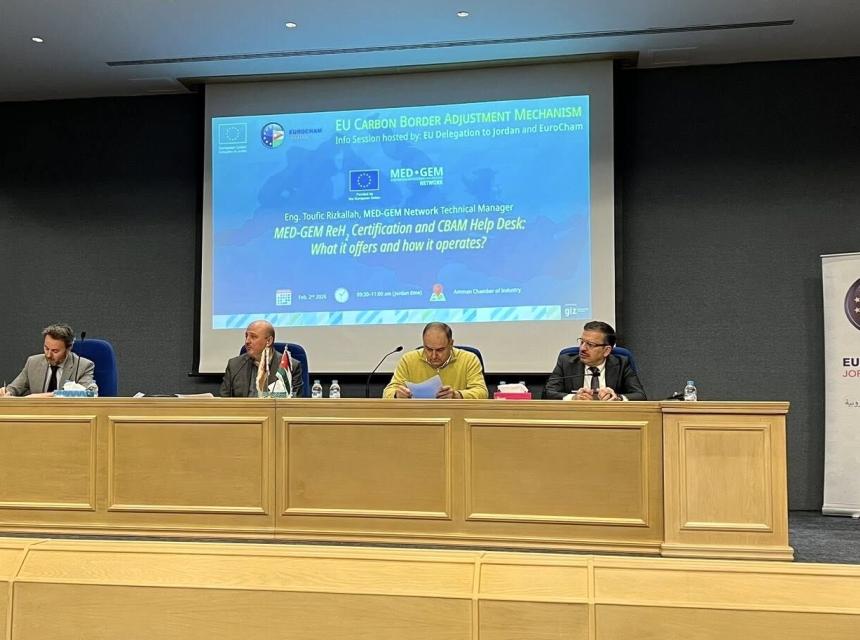
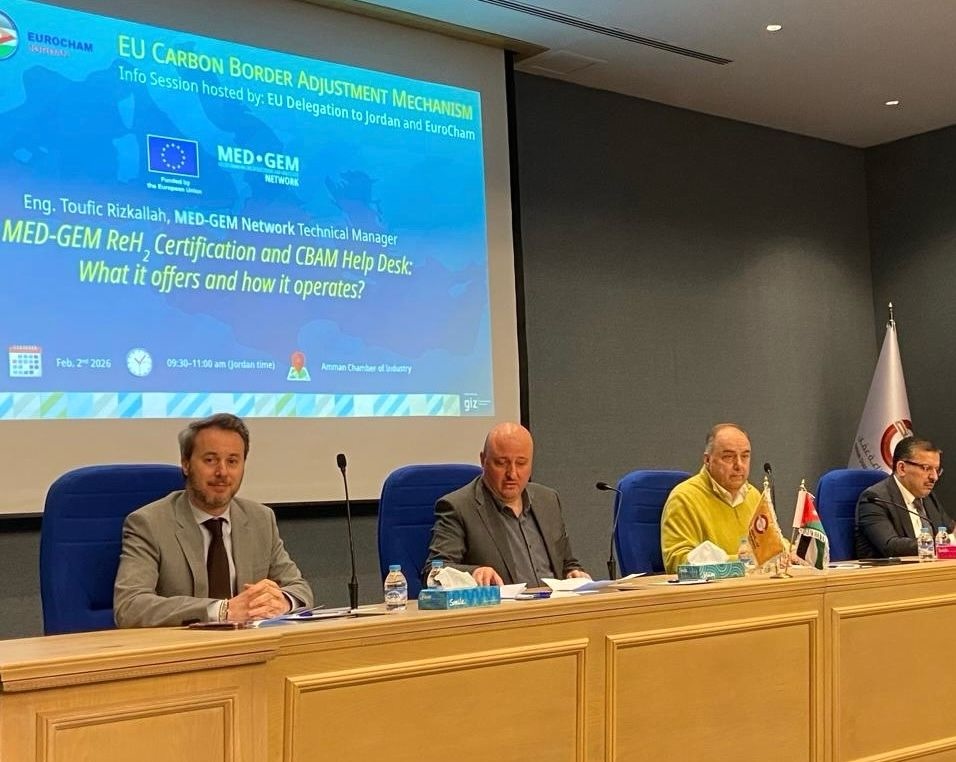
On 2 February 2026, EuroCham Jordan, in coordination with the Amman Chamber of Industry (ACI), and together with the EU Delegation to Jordan, convened an introductory information session on the European Union’s Carbon Border Adjustment Mechanism (CBAM) at the ACI premises in Amman.
The session brought together representatives from Jordan’s industrial sector and relevant stakeholders to discuss the CBAM framework, its objectives and implementation requirements, and the practical implications for Jordanian industries exporting to the European Union, especially in carbon-intensive sectors.
Why this session, why now
CBAM is a key EU climate policy instrument designed to support decarbonisation while ensuring a level playing field for trade. The information session aimed to provide stakeholders with up-to-date insights and a practical understanding of compliance pathways, including technical and operational aspects relevant to exporters.
The session was particularly relevant for companies operating in sectors covered by CBAM and related value chains, including aluminium, cement, electricity, fertilisers, hydrogen, iron and steel, as well as precursors linked to these products.
Opening remarks and institutional engagement
The event featured opening remarks delivered by Thibaut Moyer, Deputy Head of Cooperation at the EU Delegation to Jordan. He highlighted the EU’s continued engagement with stakeholders as they adapt to new requirements and the implementation phase, and thanked EuroCham Jordan for the partnership and ACI for hosting.
MED-GEM technical contribution: two complementary interventions
A dedicated segment highlighted concrete support tools available to stakeholders through MED-GEM Network, an EU-funded technical assistance project supporting the development of green electrons and molecules in the Southern Neighbourhood.
To reflect the session accurately, two distinct technical presentations were delivered:
1) MED-GEM ReH₂ Certification and CBAM Help Desk: what it offers and how it operates
Eng. Toufic Rizkallah presented the operational setup of the MED-GEM ReH₂ Certification and CBAM Help Desk, focusing on how stakeholders can access structured guidance and ongoing support.
The Help Desk offers:
- Monthly Q&A exchanges providing clarifications on technical and regulatory questions
- Quarterly thematic online sessions driven by partner-country priorities
- Access to an evolving library of FAQs, guidance notes and technical references through MED-GEM channels
The presentation also explained the Help Desk workflow, including written exchanges and optional online meetings to clarify questions and follow up points. Stakeholders are invited to submit questions via EUreg-helpdesk@med-gem.eu.
Link to the presentation of MED-GEM ReH₂ Certification and CBAM Help Desk https://drive.med-gem.eu/drive/s/63Mh4Lxvj3X29ZVGm3f9yQFLFGHDCn
2) Latest CBAM developments: technical update and emerging implementation questions
Antonio A. Fernández, CBAM expert and EU Policy and Regulatory Advisor, delivered a separate intervention focused specifically on the latest CBAM developments and practical issues emerging as stakeholders prepare for implementation.
- Link to the presentation of https://drive.med-gem.eu/drive/s/cpzOaaaeY9xp4DCYf2SEEZI4OS70Mp
Strong audience engagement and key CBAM “pain points” raised in discussion
The session concluded with a highly interactive Q&A, with strong engagement from the audience and a high volume of questions addressed to Antonio as CBAM expert. Key concerns raised by participants included:
- Uncertainty over CBAM cost exposure: stakeholders highlighted ongoing ambiguity regarding how much importers will ultimately pay under CBAM, identified as one of the most important current pain points.
- “Actual emissions” versus default values: participants underlined the complexity of calculating and verifying actual embedded emissions, the implications for the resulting carbon cost, and the likelihood that many companies may revert to default values due to uncertainty and verification challenges.
- Limited availability of CBAM-accredited verifiers: participants noted the small number of accredited verifiers and the absence of local accredited verifiers, creating an operational bottleneck for credible emissions verification.
These exchanges reinforced the value of combining an updated policy and technical reading of CBAM developments with hands-on support tools that help industry stakeholders navigate compliance pathways step by step.
Resources and next steps
To support continued engagement, stakeholders were encouraged to explore the available material and submit questions to the Help Desk.
- Help Desk page (FAQ and overview): https://med-gem.eu/help-desk
- Ask the Helpdesk (form): https://mailchi.mp/med-gem.eu/helpdesk