CBAM in Morocco: A Strategic Workshop to Move from the Transitional Phase to Operationalisation
CBAM in Morocco: A Strategic Workshop to Move from the Transitional Phase to Operationalisation
On 5 February 2026, a national workshop dedicated to the Carbon Border Adjustment Mechanism (CBAM) was held in Morocco, bringing together key institutional, industrial and technical stakeholders concerned by the mechanism’s effective entry into force on 1 January 2026.
Organised under the EU–Morocco Green Partnership by the European Union Delegation, in coordination with the Ministry of Economy and Finance (MEF), the workshop formed part of an intensified policy dialogue between the European Union and Morocco on climate action, industrial decarbonisation and economic competitiveness.
A clear political and strategic framing from the outset
The opening remarks set CBAM firmly within its political, climate and economic context.
Eric Trotemann, Head of Cooperation at the EU Delegation to Morocco, recalled that CBAM entered into force on 1 January 2026, marking the end of the transitional phase and the gradual shift towards a financial phase. He underlined that CBAM is a key regulatory instrument of the European Green Deal, designed to prevent carbon leakage, strengthen carbon pricing and support global decarbonisation.
In this context, Morocco is identified as a strategic partner of the European Union. Political and technical exchanges conducted since 2023, as well as joint projects implemented in the fields of energy transition, industrial decarbonisation and carbon pricing, reflect a structured and forward-looking cooperation. CBAM should not be seen as a penalty, but rather as an incentive to accelerate national decarbonisation pathways, including through the development of recognised carbon pricing mechanisms.
From the Moroccan side, Youssef Farhat, Deputy Director of the Budget and Chair of the MEF Climate Unit, stressed the cross-cutting and strategic nature of CBAM for the national economy. The mechanism represents both a constraint and a lever: a competitiveness challenge for certain export-oriented sectors, but also a strong signal encouraging the transformation of climate requirements into industrial and economic opportunities.
Since the launch of the EU–Morocco Green Partnership in 2022, Morocco has chosen to anticipate the transition rather than undergo it. From 2026 onwards, the shift from a declarative phase to a financial phase implies concrete challenges for Moroccan companies:
- a technical challenge, related to emissions measurement, verification and traceability;
- an economic challenge, linked to the implicit cost of carbon;
- an institutional challenge, calling for coordinated responses between the State, the private sector and international partners.
Workshop objectives: assessment, clarification and preparedness
In his introductory presentation, Gaëtan Ducroux, Energy, Climate and Environment Policy Officer at the EU Delegation, outlined the workshop’s objectives:
- to take stock of the CBAM transitional phase (2023–2025);
- to provide regulatory clarifications for Moroccan stakeholders ahead of the start of financial obligations in 2026;
- to analyse potential sectoral impacts for Morocco;
- and to offer a platform for dialogue enabling stakeholders to share challenges and preparedness needs.
He also recalled that CBAM mirrors the EU Emissions Trading System (EU ETS), which has contributed to an approximately 50% reduction in emissions from European power and industrial installations since 2005.
CBAM principles, scope and timeline
The first working session revisited CBAM fundamentals. The mechanism currently applies to six carbon-intensive sectors: iron and steel, aluminium, cement, fertilisers, hydrogen and electricity. It is based on the actual embedded emissions of imported goods, in line with rules applicable to EU producers.
Implementation is progressive:
- a transitional phase (2023–2025) focused on reporting, without financial obligations;
- a definitive phase, underway since January 2026, with a gradual increase in financial obligations alongside the progressive phase-out of free allowances under the EU ETS.
Data from the transitional phase indicate that Morocco is not among the most exposed countries. CBAM-covered products account for approximately 3.7% of Morocco’s exports to the EU, mainly fertilisers and, to a lesser extent, cement.
MED-GEM Network: operational support through the CBAM Helpdesk
Against this backdrop, particular attention was given to support tools available to partner countries.
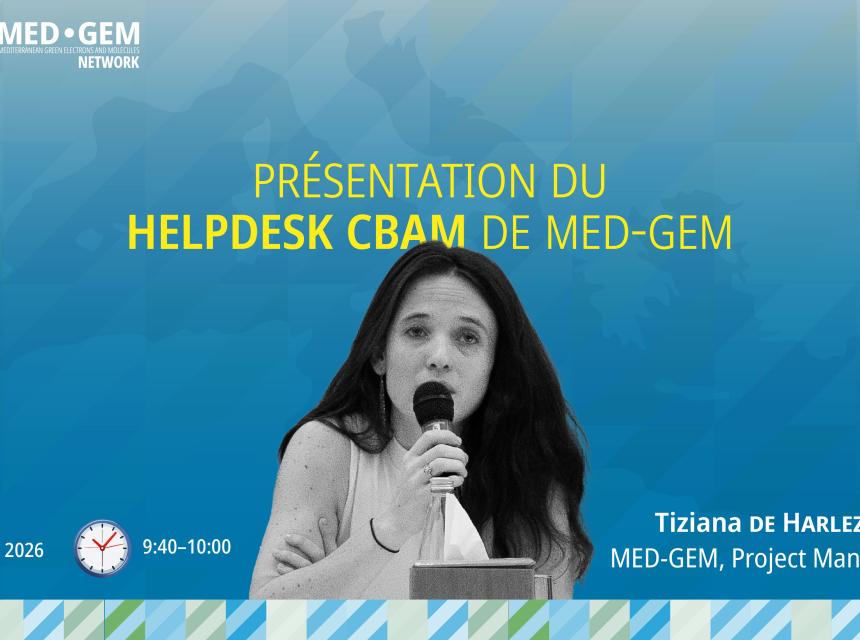
Tiziana de Harlez, Project Manager of the MED-GEM Network, presented the Renewable Hydrogen Certification and CBAM Helpdesk, developed under the EU-funded MED-GEM project and implemented by GIZ International Services.
The Helpdesk aims to:
- facilitate access to the EU market by supporting understanding of sustainability certification requirements;
- assist public and private actors in CBAM implementation;
- and help maintain the competitiveness of partner countries under evolving climate regulations.
It is structured around three pillars:
- monthly Q&A exchanges with specialised experts;
- quarterly thematic sessions on regulatory and methodological developments;
- an evolving knowledge base of FAQs, technical notes and references: https://med-gem.eu/faq
Operating through a simple monthly cycle, the Helpdesk enables stakeholders to submit questions by email and, when needed, engage directly with experts.
From dialogue to action
This first part of the workshop laid the foundations for a structured and forward-looking dialogue between European institutions, Moroccan authorities, technical assistance projects and economic actors. It confirmed that CBAM represents less an immediate shock than a strategic signal, calling for progressive, coordinated and anticipatory responses.
Subsequent sessions further explored Morocco-specific impacts and national preparedness initiatives, within a co-construction approach addressing short-, medium- and long-term challenges.