
From Momentum to Market: MED-GEM’s 6th Steering Committee
From Momentum to Market: MED-GEM’s SIXTH Steering Committee
Abu Dhabi, 14 January 2026
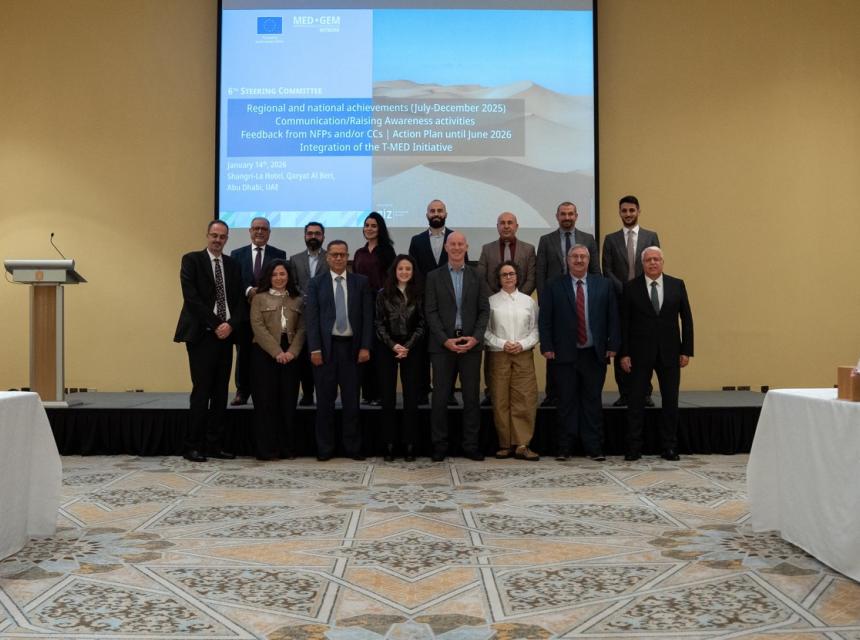
The MED-GEM Network 6th Steering Committee convened in Abu Dhabi at a pivotal moment for the Mediterranean and GCC energy transition. As renewable deployment accelerates, costs reach historic lows, and green hydrogen moves from vision to market reality, one message resonated throughout the discussions: delivery now depends on bankability, infrastructure and regulatory clarity. Bringing together project leadership and national representatives from across the Southern and Eastern Mediterranean, the meeting provided both a regional snapshot and a forward-looking roadmap for 2026
A region accelerating, markets maturing
Across the Mediterranean and the GCC, renewable energy deployment is advancing at unprecedented speed. Large-scale solar and wind projects are no longer niche. They are becoming the backbone of national power systems, supported by rapidly expanding energy storage capacity.
Hybrid models combining solar, wind and batteries are emerging as the new standard, enabling firm power and supporting energy-intensive demand such as data centres and industrial clusters. Record-low renewable prices, particularly in GCC markets, are reshaping competitiveness and setting new global benchmarks.
Yet scale brings new challenges. As renewable penetration rises, grid integration, flexibility and long-duration storage are no longer optional. They are structural requirements.
Green hydrogen: ambition meets reality
Green hydrogen featured prominently in the discussions, not as a future promise, but as a sector undergoing rationalisation.
While project pipelines continue to grow, only a limited number of projects have reached financial close or construction. The gap between announced ambition and bankable delivery remains significant.
Steering Committee members converged on three critical enablers:
- Credible off-take pathways, supported by predictable regulation
- Common-user infrastructure, reducing costs and risk for first movers
- Bankability frameworks, addressing cost of capital disparities across the region
Without these elements, hydrogen risks remaining locked in feasibility studies. With them, it becomes an investable market.
MED-GEM’s role: from policy to practice
Over the second half of 2025, MED-GEM shifted to EU-partner-ready visibility and delivery packages, designed to translate policy into action.
Key achievements highlighted in Abu Dhabi included:
- The dissemination of the Local Value Chain consultation report, mapping pathways for clean tech manufacturing and regional industrial competitiveness
- The launch of the Industrial Circle, anchoring dialogue with industry associations, academia and implementers
- Delivery of a regional finance training, equipping institutions and developers with tools to structure bankable projects
- Expansion of the CBAM and renewable hydrogen certification Helpdesk, now a trusted reference for translating EU regulatory complexity into practical guidance
MED-GEM’s value lies in its positioning: bridging policy, finance, industry and skills, while remaining grounded in implementation realities.
Countries in motion: shared challenges, tailored pathways
The country tour de table confirmed strong momentum across the region, albeit with differentiated starting points.
Jordan outlined ambitious renewable and storage plans, coupled with regulatory reforms enabling hydrogen investment and common infrastructure development.
Palestine highlighted rapid solar deployment, growing integration of storage and the strategic role of MED-GEM in introducing hydrogen into national policy and academic ecosystems.
Egypt reported accelerated renewable targets, grid-driven battery integration and continued market reform.
Morocco stressed the urgency of CBAM readiness and certification of origin systems as a condition for future trade.
Lebanon marked a major governance milestone with the appointment of an independent electricity regulator and advanced work on decentralised hydrogen for industrial heat.
Tunisia showcased fast-moving renewable deployment, pilot battery projects and growing interest in export-oriented interconnections.
Despite national differences, common priorities emerged: certification, storage, grid readiness, and access to finance.
2026: aligning momentum with investment
Looking ahead, MED-GEM’s January–June 2026 work-plan focuses on turning readiness into delivery.
Planned actions include:
- Scaling up the Helpdesk and targeted information sessions on CBAM, certification and sustainable fuels
- Convening the T-MED “Metro Map” workshop to clarify roles and complementarities across the Euro-Mediterranean energy ecosystem
- Advancing women and youth engagement through dedicated hydrogen initiatives
- Continuing national-level technical assistance on infrastructure, bidding zones, hydrogen feasibility and skills
The objective is clear: ensure that Mediterranean green ambition translates into concrete investment, infrastructure and jobs, fully aligned with the EU’s Global Gateway and the Pact for the Mediterranean.
This 6th Steering Committee confirmed that the Mediterranean is no longer asking whether the green transition will happen, but how fast it can be delivered.
By connecting policy to projects, finance to fundamentals, and ambition to bankability, MED-GEM is helping the region move decisively from momentum to market.