From matchmaking to bankability: what funders need to see
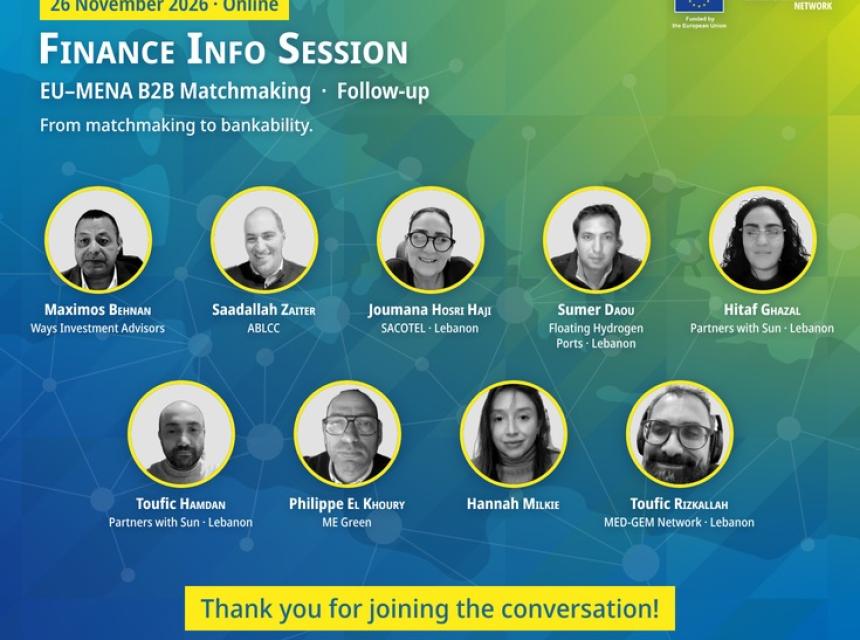
MED-GEM Finance Info Session · 26 November 2026 · Online
The EU–MENA B2B matchmaking organised by MED-GEM Network and the Arab-Belgian-Luxembourg Chamber of Commerce (ABLCC) at European Hydrogen Week 2026 led to 186 meetings and 73 agreed follow-ups. To carry those conversations forward, the EU-funded MED-GEM Network brought the participating MENA project teams back together online on 26 November, around one question: what must a project have ready before it approaches lenders and investors?
Capital is not the bottleneck
Maximos Behnan, CEO of Ways Investment Advisors, opened by challenging the idea that capital is scarce. In his view, more than USD 100 trillion could be accessible to projects that are properly prepared. The bottleneck comes earlier: around 80% of infrastructure projects fail at the feasibility or business-plan stage, before they ever reach a funder. The region has real project demand and real investor interest, he noted. What holds projects back is packaging, especially when technical sponsors must produce the financial, business and ESG documentation that funders now expect.
What funders test
Lenders ask how they will be repaid, equity investors what return they can expect, and development finance institutions (DFIs) what development impact a project will deliver. All three start with mandate fit: a project outside a funder’s country and sector mandate will not be considered. Behnan then walked through what a funder looks for in the file:
- a funding request built bottom-up from market data and vendor quotations, with stated assumptions, and sized to the project’s current stage;
- contracted revenue, not only revenue under discussion: letters of intent and non-binding MoUs are not secured revenue, and the buyer’s credibility and payment safeguards are assessed too;
- permits and grid connections started early, each tracked with a clear status;
- a feasibility study by an independent, recognised third party, which a sponsor- or vendor-produced study cannot replace;
- sponsor experience, or an experienced operating partner with a meaningful role in the project;
- a live financial model whose figures trace back to source documents;
- risks identified, mitigated and allocated, including currency, credit and country risk, with environmental and social impacts addressed from the outset.
Readiness is not bankability
Readiness checks whether the required elements are in place. Bankability tests whether they are valid and acceptable to a funder, and the requirements vary by project type. A readiness assessment followed by a gap analysis shows what is missing, which evidence is needed, who owns each item and by when. For new concepts, Behnan recommended proving the model on one operating site before seeking finance for a larger, phased roll-out.
From the floor
In the discussion moderated by Saadallah Zaiter, Deputy Secretary-General of ABLCC, developers raised the barriers they meet in practice. On the cost of independent feasibility studies, Behnan pointed to grants, qualifying DFI programmes, an operating partner or a smaller first phase. On markets perceived as higher-risk, he advised targeting funders with the right mandate and regional experience, and judging each institution by its mandate rather than by presumed preference. For smaller developers facing cost and guarantee hurdles, conditional binding MoUs carry more weight in financing talks than non-binding ones. The early-stage funding gap facing blue economy projects remained an open question.
Next steps
MED-GEM Network will share the readiness assessment and the speaker’s contact details with participating projects that wish to take the discussion further, and one project team has agreed to share its investor materials and funding history for a closer review. The track continues in Brussels on 2 December, when the MED-GEM Network Closing Event dedicates a session to moving from matchmaking to partnership, with the signing of business MoUs.
Read the EU–MENA matchmaking results →
The session was for general information and education only. It did not constitute investment advice or an offer of any kind.
MED-GEM Network is funded by the European Union and implemented by GIZ International Services.