
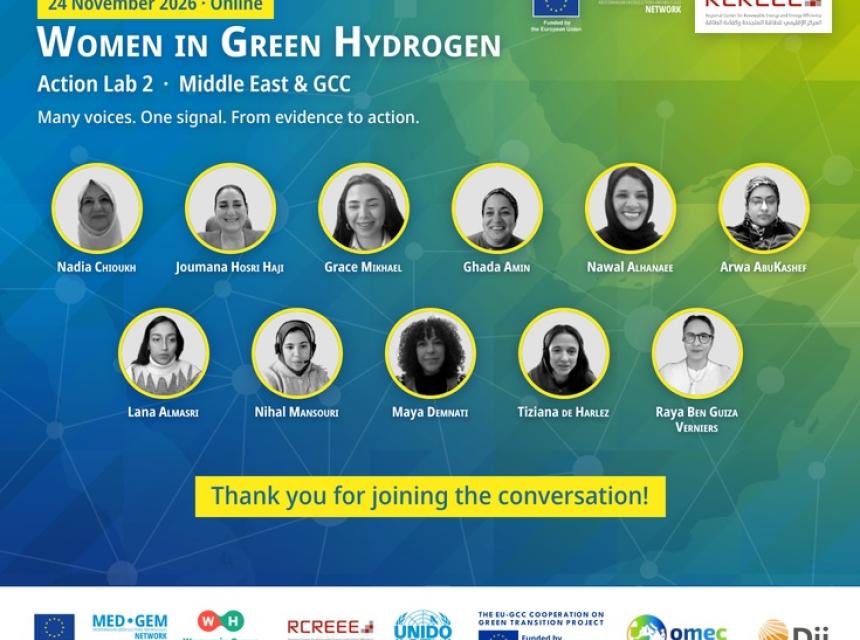
Access, not ability: Action Lab 2 sets first priorities for women in green hydrogen
On 24 November 2026, Action Lab 2 of the Women in Green Hydrogen series brought together experts from the Middle East, the Gulf, North Africa and Europe. Their conclusion was clear: women's expertise in green hydrogen already exists, and the gap is access to projects, decision-making and finance.
Led by MED-GEM Network, with the Regional Center for Renewable Energy and Energy Efficiency RCREEE as strategic regional supporter and Women in Green Hydrogen (WiGH) North Africa as partner, the 90-minute online session followed four verbs: connect, understand, collaborate and activate. It builds on Action Lab 1, held with North Africa on 14 September 2026, and on the regional campaign Many Voices. One Signal. Its two outputs are an opt-in expert mapping of women across the hydrogen and renewables value chain, and a challenge matrix of barriers, needs and one priority per country.
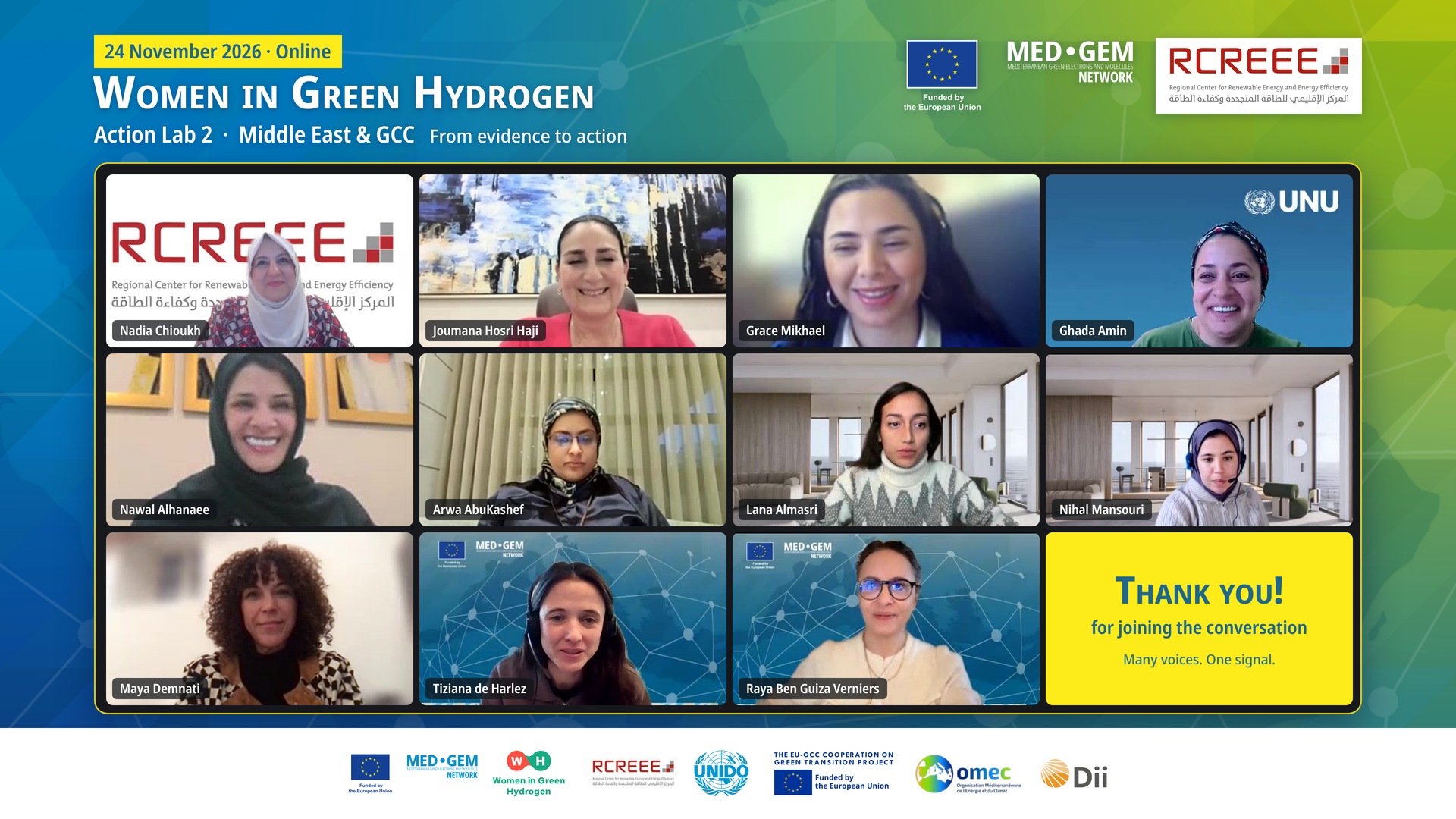
Opening the session, Nadia Chioukh, Director of International Cooperation and Strategic Partnerships at RCREEE, set the tone: "We don't need the market to be established to address the gender gaps."
What the evidence says
Nihal Mansouri, Regional Director of WiGH North Africa, drew four lessons from Action Lab 1: start national and think regional; evidence beats anecdotes; the gap is not skills but influence; and timing matters.
Managing Director of Moroccan Danish Chamber of Commerce and Industry (MDCCI), Maya Demnati representative of WiGH Morocco Chapter presented the North Africa mapping of 53 women from five countries.
- More than half work in renewable energy, almost half in project development and one in three in hydrogen production and electrolysis.
- More than half lack access to specialised technical training.
- About half see their biggest opportunity in the projects now taking shape.
"The talent is there. Access is the gap," she said.
Nadia Chioukh described the mapping as an initial exercise, not a statistical assessment. Expertise exists but does not automatically translate into participation, and training alone is not enough. What is needed, she concluded, is a regional framework that accommodates national realities.
Voices from the region
Joumana Hosri Haji, General Manager of SACOTEL (Lebanon), entered solar more than ten years ago, without quotas or gender incentives. "I'm not worried about retention," she said. "Our problem is access."
Grace Mikhael, MED-GEM Country Correspondent for Lebanon, noted that women make up 15% of staff and 6% of technical departments at Électricité du Liban (World Bank, 2022). The solar market that grew during the electricity crisis opens new entry points, and so does Law 318 of 2023 on distributed renewable energy. Green hydrogen is still new in Lebanon, so it can be built with women from the start.
Dr Ghada Amin, Researcher at the United Nations University (UNU Resource Nexus), linked hydrogen to biodiversity. She pointed to desalination brine discharged into the Red Sea or the Mediterranean, wind and solar plants along a migratory bird corridor, and the cumulative impact of several projects on one site.
Eng. Nawal Alhanaee, Director of Future Energy at the UAE Ministry of Energy & Infrastructure, said the hydrogen economy can draw on women already working in renewable power, process engineering, water and environmental assessment, finance and regulation. Visible career pathways, she added, help keep them in the sector.
In the discussion, Arwa AbuKashef, Senior Engineer in the Energy Transition Department at Jordan's Ministry of Energy, proposed national communities that meet regularly and connect regionally. Lana Almasri, a Syrian energy expert based in Berlin, called for Arabic-language access to include women from conflict-affected countries such as Syria, Palestine and Iraq.
Recommendations
- Open doors to real projects. Pilot six one-year placements of women, at early-career and senior levels, with three hydrogen developers, incentivised through visibility, introductions to lenders and better scoring for women-led suppliers. Joumana Hosri Haji offered to introduce the first developer.
- Involve women from the design stage. Give women a meaningful role in Lebanon's green hydrogen roadmap, and make environmental and social expertise part of project leadership from site selection onwards.
- Make careers sustainable. Support caregiving and flexible work, and make women's seats on decision-making committees mandatory.
- Build bankability literacy. Train women on what makes a project bankable and how to pitch to funders.
- Turn the mapping into a mechanism. Create national communities with regular exchanges, connected regionally, with Arabic-language access so that no one is left out because of language.
- Widen the evidence. Extend the mapping to environmental and social impact assessment and community engagement roles, and to countries not yet on the map, such as Lebanon and Syria.
Next steps
MED-GEM Network and RCREEE will consolidate the mapping and the challenge matrix, and carry the findings to the MED-GEM Closing Event in Brussels on 2 December 2026, under the theme From Evidence to Policy.
The mapping stays open.
3 minutes. Two regions. Your voice. Help turn women's expertise into evidence and action:
- North Africa (Algeria, Egypt, Mauritania, Morocco, Tunisia): forms.gle/iChFV2ShfKgpYMJh7
- Middle East & GCC (Lebanon, Palestine, Jordan and the Gulf): forms.gle/gHw4tnAjMRQfWCGb9
Share the forms and tag women in energy in your networks.
- Watch Action Lab 2 on YouTube
- Access the Action Lab 2 Keynote
Read the Action Lab 1 findings, watch Action Lab 1 and follow the Many Voices. One Signal. campaign.
MED-GEM Network is funded by the European Union and implemented by GIZ International Services. The Women in Green Hydrogen Action Labs are a MED-GEM communication and stakeholder-engagement initiative, aligned with the principles promoted by the European Commission's Equality Platform for the Energy Sector. They are not an official activity of the Platform.