From skills to influence: North African women define the next priorities for green hydrogen
Five countries, one regional conversation, and a clear signal: the talent is already there. The challenge is connecting women’s expertise to the places where green hydrogen projects are designed, financed, implemented and governed.
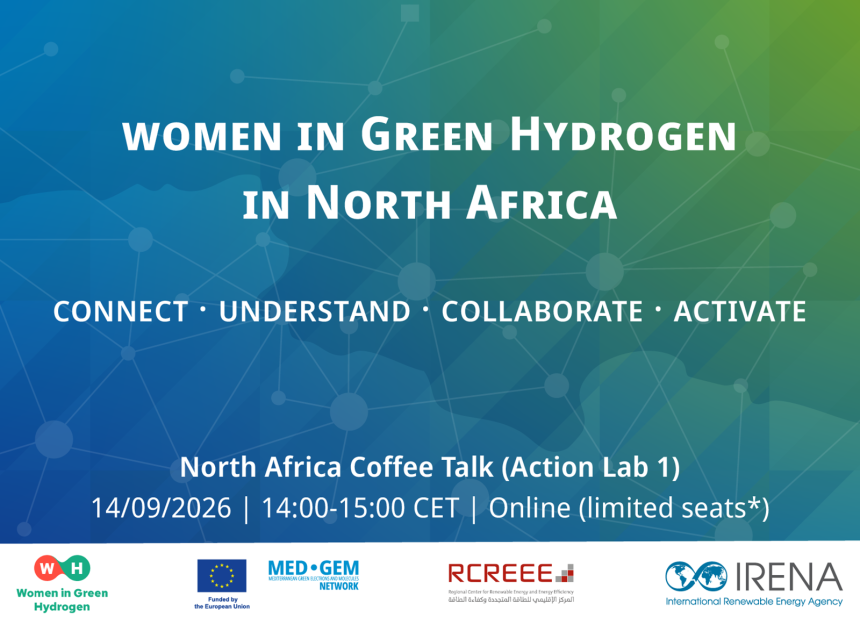
On 14 September 2026, the Women in Green Hydrogen North Africa Coffee Talk / Action Lab 1 brought together the Women in Green Hydrogen North Africa community and the EU-funded MED-GEM Network around a deliberately practical format: one hour, five country conversations, three common questions and two intended outputs: an opt-in mapping of women’s expertise and a North Africa Challenge Matrix.
The mobilisation around the session showed strong regional interest from the five focus countries: Morocco, Egypt, Algeria, Tunisia, Morocco and Mauritania.
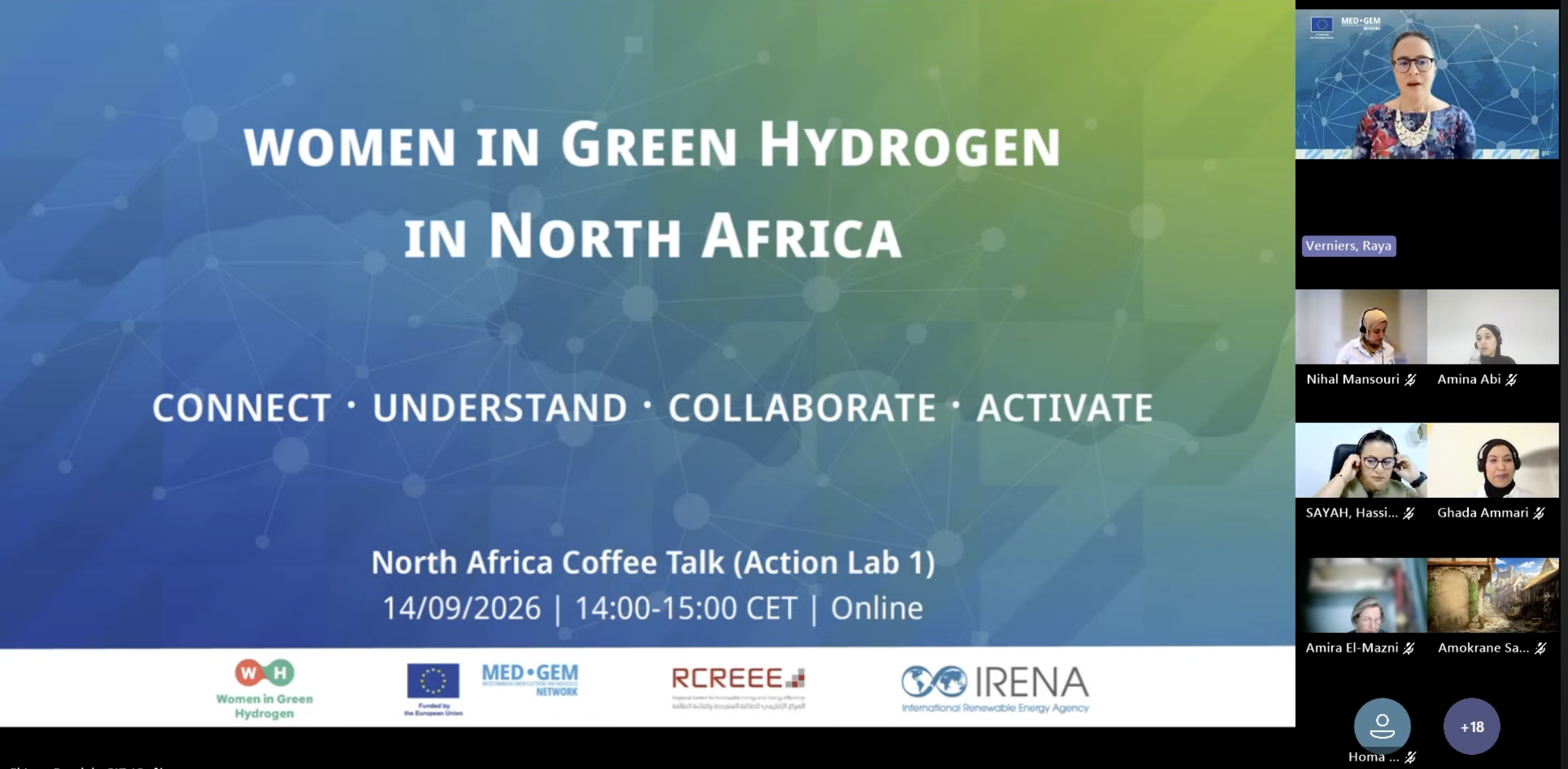
▶️ Watch Women in Green Hydrogen North Africa | Action Lab 1: From Skills to Influence
Five countries, three questions
Rather than another webinar, the Action Lab was designed as a working session. Participants moved into five country breakout rooms led by Radia Lasledj for Algeria, Eman Adel for Egypt, Hana Didi Bounama for Mauritania, Nihal Mansour for Morocco and Ghada Amari for Tunisia.
Each room worked around the same three questions: Where are the women? What is holding women back? What should we activate next? The objective was not to solve every structural challenge in twenty minutes, but to identify three comparable signals from each country: existing expertise, the main barrier and one realistic priority for action.
The preliminary mapping reinforces a common regional finding: North Africa does not lack qualified women. It lacks enough bridges between existing expertise and real opportunities.
Across the responses, women are already strongly present in research, STEM disciplines, renewable energy and engineering. Yet their visibility decreases in the roles where projects move from concept to delivery: project development, operations, finance, industrial implementation, governance, leadership and decision-making. The recurring barriers include limited access to specialised and hands-on experience, professional networks and mentoring, unclear career pathways and insufficient access to leadership positions.
Different national contexts, one shared direction
The five country conversations enter the regional picture from different starting points.
In Algeria, the challenge is increasingly about turning a strong base of scientific and technical talent into real industrial, project-development and leadership roles, while opening more space for women-led entrepreneurship across the hydrogen value chain.
In Egypt, the priority is to build the female talent pipeline before the hydrogen market reaches scale — ensuring that women are positioned early in engineering, research, entrepreneurship, integrated hydrogen ecosystems and decision-making.
For Mauritania, access remains central: access to technical skills, networks, employment, finance and leadership. Because the sector is still at an early stage, there is also a rare opportunity to build a first generation of women professionals into the industry from the outset.
In Morocco, the discussion is moving from representation towards influence. As projects become more structured, the opportunity is to bridge the gap between education and employment and move women from research and support functions into industrial implementation, project development, finance, standards and strategic decision-making.
In Tunisia, the emphasis is similarly practical: convert existing technical and scientific capacity into visible employment and leadership pathways through specialised training, certifications, internships, mentoring and direct connections with companies, research institutions and project developers.
Across countries, participants consistently pointed towards capacity building, thematic working groups, professional visibility, technical collaboration, mentoring and peer-to-peer support as the kinds of mechanisms that could turn a network into an active professional community.
From country signals to regional action
The plenary brought these five national conversations back together before adding two wider perspectives: Nadia Chioukh, Director of International Cooperation & Strategic Partnerships at RCREEE, was invited to connect the findings with regional patterns, institutional gaps and potential synergies, while Gauri Singh, Deputy Director-General of IRENA, contributed an international perspective on where expertise, networks and future collaboration could connect with the needs emerging from North Africa.
This first Action Lab is therefore not intended as a stand-alone event. Its value lies in what comes next.
MED-GEM and WiGH will now consolidate the country inputs into the North Africa Challenge Matrix and continue developing the opt-in expert mapping. These findings are expected to feed a Middle East / GCC Action Lab 2, followed by a broader MENA–GCC evidence synthesis.
The wider pathway will then use futur events as an advocacy and visibility milestone, before moving towards a consolidated Action Lab 3 and the MED-GEM Closing in December, where the evidence gathered can contribute to the discussion on future cooperation and possible follow-up in 2027.
Many voices. One signal.
The first North Africa Action Lab delivered a message that is both simple and strategic: women should not enter the green hydrogen economy after the structures, teams and decisions are already fixed. They need to be part of building them.
That is the direction of the wider Women in Green Hydrogen EU–MENA–GCC Action Lab pathway: moving from visibility to evidence, from evidence to collaboration, and from collaboration to advocacy and measurable action.
👉 Contribute to the WiGH MENA-GCC mapping
MED-GEM Network is funded by the European Union and implemented by GIZ International Services.