CBAM Enters the Verification Era: What Mediterranean Exporters Need to Prepare Now
MED-GEM Help Desk Info Session | 6 October 2026
As the EU Carbon Border Adjustment Mechanism, CBAM, enters its definitive phase, the challenge for exporters is becoming increasingly practical: how to measure embedded emissions, prepare reliable data and get that data verified.
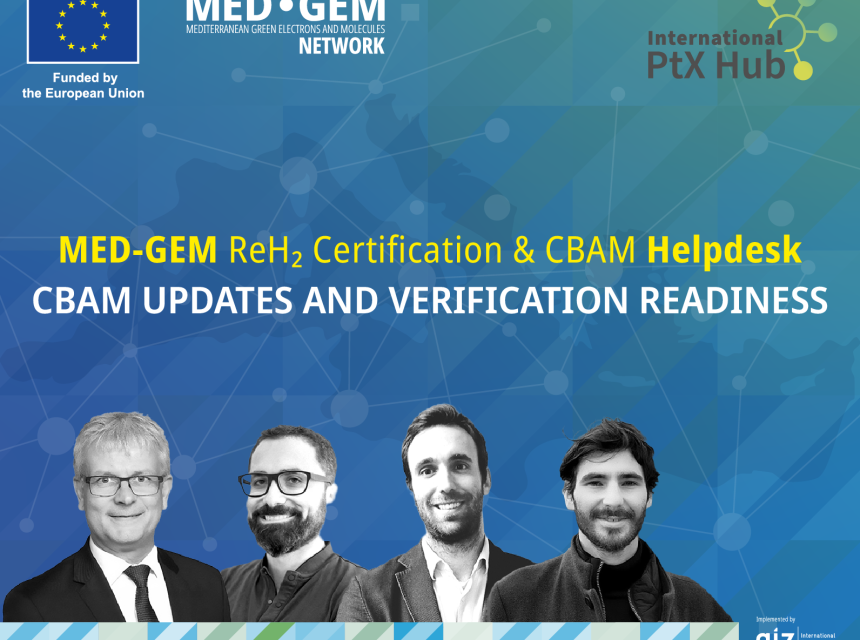
This was the focus of the latest MED-GEM ReH₂ Certification and CBAM Help Desk Quarterly Info Session, bringing together regulatory guidance from the European Commission with lessons from an industrial pre-verification exercise.
Opening the session, Toufic Rizkallah, MED-GEM Network Technical Manager, recalled that the Help Desk has been supporting Southern Mediterranean companies and stakeholders for two years through monthly Q&A cycles, quarterly expert sessions and a growing online FAQ.
CBAM moves from reporting to verification
Klaus Röhrig, Policy Officer at the European Commission’s DG TAXUD, presented the latest developments following CBAM’s entry into its definitive phase on 1 January 2026.
CBAM currently covers iron and steel, aluminium, hydrogen, electricity, cement and fertilisers. Importers can rely on Commission default values or report actual embedded emissions.
The difference is critical: default values are designed conservatively and include a markup, while companies wishing to use actual emissions must have those figures verified by an accredited independent verifier.
This makes verification a central element of CBAM readiness.
➡️ Download the DG TAXUD presentation on CBAM accreditation and verification
Who can become a CBAM verifier?
A verifier established either inside or outside the EU must obtain accreditation from an EU National Accreditation Body before verifying emissions under CBAM.
During the session, DG TAXUD indicated that national accreditation bodies in France, Greece, Italy, the Netherlands, Poland and Sweden had already opened application procedures to third-country verifiers.
Applicants must demonstrate technical competence, independence and impartiality and comply with relevant standards, including ISO 17029 and ISO 14065. Existing EU ETS verifiers may, in certain cases, build on their current accreditation when extending their scope to CBAM activities.
For Mediterranean technical service providers, this creates a concrete emerging market for CBAM verification expertise.
From regulation to industrial reality
The second part of the session focused on lessons from a CBAM pre-verification pilot at HyIron in Namibia.
Antonio Fernández, MED-GEM Policy and Regulatory Advisor, presented the pilot and the main operational lessons, while Rainer Winter, EU ETS Verifier, provided the verifier’s perspective.
The exercise showed that verification is not simply a final compliance check. It depends on the quality of monitoring systems, documentation, data traceability and internal responsibilities long before a verifier arrives on site.
➡️ Download Antonio Fernández’s presentation – Pilot lessons from HyIron in Namibia
➡️ Download Rainer Winter’s presentation – A verifier’s view and lessons learned
What should exporters prepare now?
The session highlighted several immediate priorities for companies exporting CBAM-covered goods to the EU:
• assess whether using actual emissions instead of default values could provide an advantage;
• strengthen emissions monitoring and data-management systems;
• ensure documentation and traceability are verification-ready;
• clarify responsibilities between producers, exporters and EU importers;
• engage early with verification expertise.
The message is straightforward: CBAM readiness now means verification readiness.
Companies that prepare their systems and emissions data early will be better positioned to demonstrate their carbon performance and respond to the requirements of the definitive period.
Watch, listen and continue the conversation
Missed the session or want to revisit the discussion?
🎥 Watch the full MED-GEM Help Desk session on YouTube
🎧 Listen to the session as a podcast on Spotify
The MED-GEM Help Desk continues to support Southern Mediterranean stakeholders with practical guidance on CBAM, renewable hydrogen certification and related regulatory requirements.
📚 Explore around 100 questions already addressed in the Help Desk FAQ
💬 Have a question? Submit it to the MED-GEM Help Desk
MED-GEM Network is funded by the European Union and implemented by GIZ International Services.